
Our favorite components for Jack’s music system
If you are familiar with “Jack and the Beanstalk” you will recall he likes to listen to the Magic Harp. He also needs instruments to slay the Giant.
In this space, we will feature audio components of exceptional value that slay components that have gigantic prices.
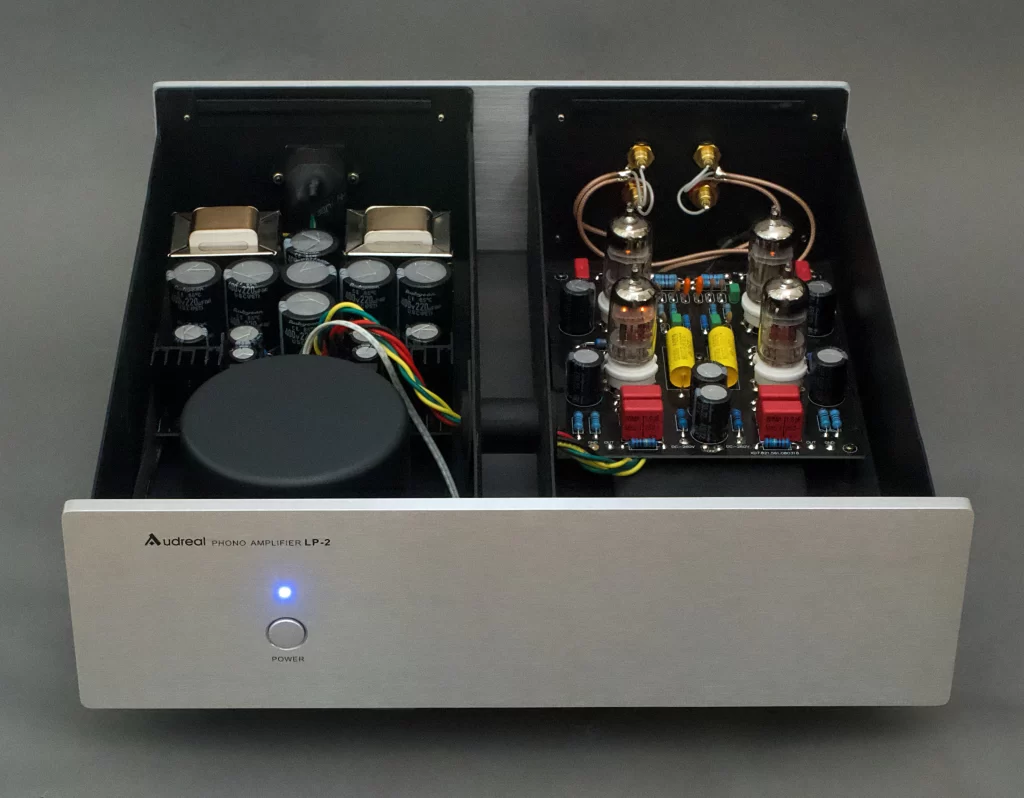
The Audreal LP-2 phono stage is a true Giant killer against all other transistor units. Why?- because it is a vacuum tube circuit.
Designers like to target low noise with silly little op-amps and transistors in units selling for over fifteen thousand dollars. But in that pursuit, music dries up and disappears.
The Audreal LP-2 places no solid state parts in the signal path and the reward is instantly revealed when you cue the first LP. A broad palette of musical harmonics, bold dynamic shifts, and a richness that will make analog playback captivating.
This is easily accomplished with affordable cartridges since the Audreal LP-2 is built for medium to high output cartridges that require standard 47K loading. We will feature some of our favorites later in this space.
We have enjoyed this phono stage for many years. At the 2011 Consumer Electronics Show it was playing in our exhibit when Michael Fremer dropped in. I just watched a video my son and I made while he was listening. It was during the closing hours of the show and he proclaimed that our modestly priced Audreal system was in the top 3 of all that he had heard that week, amongst systems that were approaching one million dollars.
Michael requested a review sample and we complied. A fantastic review of our room was covered in Stereophile Magazine soon after the show. The Audreal LP-2 review he wrote introduced the phono stage to happy buyers throughout the U.S.A. and Canada.
This giant killer is a formidable beast built with very heavy gauge metal for noise shielding and heat sinking. The massive toroidal power supply is in a separate enclosure from the tube gain stage. We have never had to service one in all these years.
My unit still has the original tubes. (knocking wood now)

Jack chose the Audreal PA-20 Class-A amplifier for his system
After he read this review it was a natural fit.

Audreal PA-20 Class-A Power Amplifier Reviewed
Can a relatively unknown and inexpensive amplifier impress Terry London? Turns out there’s lots to recommend with Audreal’s latest offering.
- Terry London
Terry London has always had a great passion for music, especially jazz, and has amassed a collection of over 7,000 CDs covering the history of this uniquely American art form. Even in his teenage years, Terry developed a passion for auditioning different systems and components to see if they could come anywhere close to the sound of live music, and has for the last forty years had great fun and pleasure chasing this illusion in his two-channel home system.
Terry is a practitioner of Rational Emotive Behavior Therapy by day, and runs the Chicago Institute for REBT. He has also authored nine books on this of type psychotherapy and education. - One of the many fun aspects of being a staff reviewer at HomeTheaterReview.com is that I receive many emails from readers informing me of some of their “finds” regarding new pieces of gear that have caught their fancy because of their stellar performance. Some of these emails made reference to a new and relatively inexpensive amplifier called the Audreal PA-20, retailing for $1,995. The Audreal PA-20 amplifier is sold by the manufacturer so that the price of the PA-20 reflects an Internet-direct price instead of having to add the cost of an importer/retailer fee.
- Upon opening the heavy-duty carton containing the Audreal PA-20, my first thought was that maybe the wrong amplifier had been sent to me. It was hard to believe that an amplifier retailing for less than $2,000 could have such exquisite case work. The front plate is a half of an inch thick, and there’s a pair of massive sculptured heatsinks. The review sample weighed 48.5 pounds, and its dimensions were 17.9 inches wide, 10 inches deep, and 4.9 inches high. The front plate has a centered main power button, flanked by two large, blue-backlit, retro-looking power meters. The back of the amplifier has a centered IEC input, a toggle switch for choosing XLR or single-ended inputs, and a pair of very high-quality speaker posts that can accept either banana plugs or spades. The Audreal PA-20 amplifier’s first 20 watts into eight ohms is pure Class A, hence the need for the massive heatsinks. After the first 20 watts of pure Class A, the PA-20 offers 6 dB of Class A/B watts up to 120 watts. During the entire review process, I was never able to clip the Audreal PA-20 amplifier, even though the system it was in was auditioned with played at very high levels.
- As soon as I started to listen to the PA-20, it became apparent that its performance was going to match its well-built construction and physical appearance. My first musical selection was the jazz classic The Sidewinder (Blue Note) by Lee Morgan. The Audreal PA-20’s tone and timbres are what you would expect from a Class A design. Lee Morgan’s trumpet was silky and smooth and had just the right “bite” that a brass horn can deliver. Billy Higgins’ cymbals had excellent extension and air, with very clear decays. This also showed how quiet the PA-20 was because the level of transparency allowed the micro-details to be heard easily.
- My next selection was the cut “Sledgehammer” from Peter Gabriel’s album So (Griffin) to test two areas of performance. First, the type of macro-dynamics the Audreal PA-20 amplifier had, along with its ability to produce low-end extension. Secondly, what type of soundstage and width/height/depth the Audreal PA-20 was capable of manufacturing. Regardless of the volume, this selection gave me all the gut-pounding bass with tautness and accuracy, making this music come alive. The soundstage was very deep and wide with very good layering, considering this was a studio recording.
- My final selection was Billie Holiday’s classic “Body and Soul” from her album Body and Soul (Verve). If a Class A amplifier is working its magic, the midrange of music should contain warmth in its timbres and air around the individual performers. The Audreal PA-20 had these qualities, which allowed the emotion and meaning of Billie Holiday’s rendition of this powerful song to be easily experienced.
- High Points
- The Audreal PA-20 offers extremely high build quality and a very handsome physical appearance.
- Because the Audreal PA-20 has a very low noise floor, little details of the music can be heard in an effortless way.
- The overall timbres and tone of the Audreal PA-20 are silky and sweet, based on its first 20 watts of pure Class A power.
- The Audreal PA-20 delivers taut and accurate low-end extension.
- Having a 6dB headroom, it can power most speakers regardless of their sensitivity or the size of your listening space.
- Low Points
- The large, blue-lit power meters can not be dimmed or shut off. Therefore, some listeners might find this a visual distraction.
- Because the Audreal PA-20 runs up to 20 watts in pure Class A bias, it runs somewhat hot and cannot be easily placed in an enclosed stand or rack.
- Competition and Comparison
In the price range of the Audreal PA-20, two amplifiers that would be its true competitors are the Rotel RB-1582 retailing for $1,650 and the NAD C 275 BEE retailing for $1,400. Both of these amplifiers are well-built and offer good, solid performance; however, they fall quite short of the Audreal PA-20’s performance in virtually every sonic parameter. The level of transparency, the accuracy of timbres, overall dynamics, and purity of tone are at a much higher level in the Audreal PA-20 compared with these two other amplifiers.
Conclusion
The Audreal PA-20 amplifier is a very natural, musical-sounding solid-state amplifier. Considering its build quality, performance, and price, I believe it’s one of the greatest bargains on the market today. One would have to spend at least another two to three thousand dollars to purchase a better-sounding solid-state amplifier than the Audreal PA-20. I highly recommend this very reasonably priced amplifier to audition for its great ability to deliver a natural and musical perspective on all genres of music.